


Article: Crib Sheet Size: What Size Do You Need and How Many?
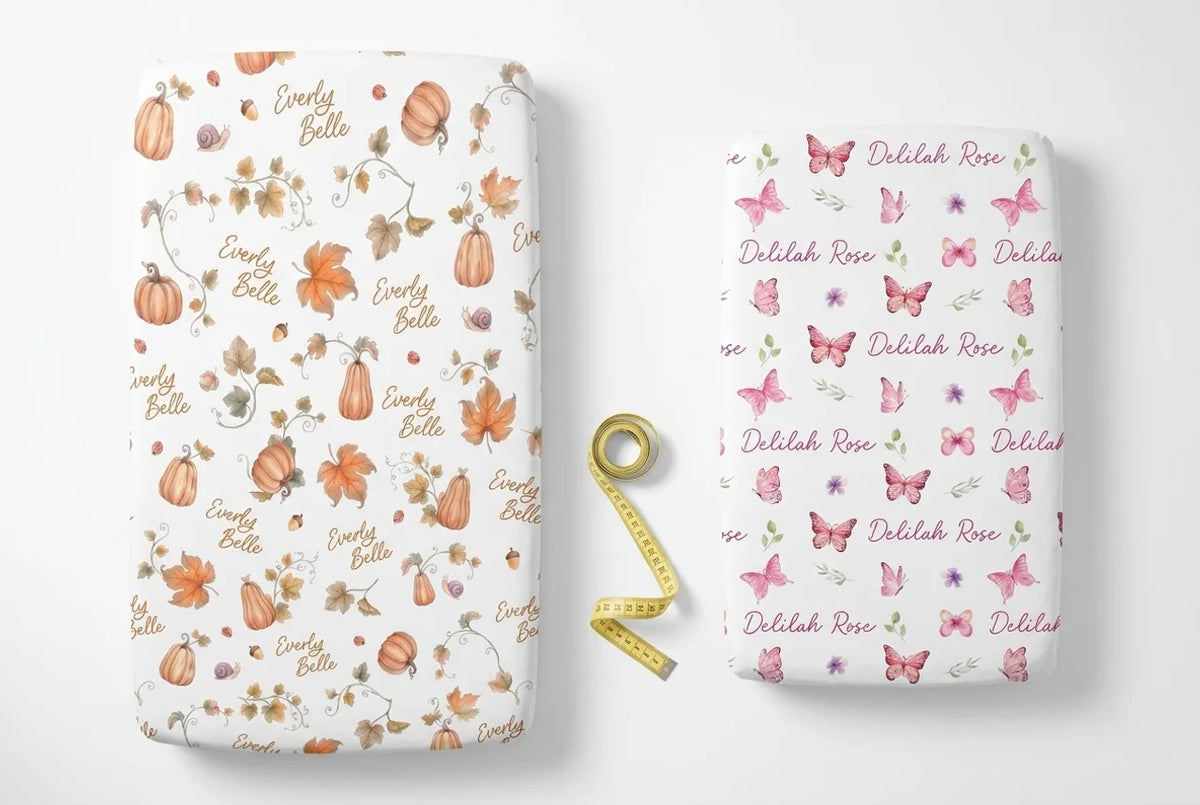
Crib Sheet Size: What Size Do You Need and How Many?
Two mattress sizes, the one measurement people skip, and an honest number for how many sheets to keep on hand.
Buying a crib sheet looks like the easiest item on the list. Then the mattress arrives, the sheet goes on, and one corner springs loose the moment you tuck the opposite one. Usually the fabric isn't the problem. The crib sheet size simply doesn't match the mattress underneath it.
This guide answers the two questions that almost always arrive together: what size to buy, and how many. Both have short answers, and both are much easier to get right before you order than after.
If you're here because a bassinet is being outgrown, our guide to the bassinet to crib move covers the when — the signs, the pacing, the one-change-at-a-time approach. This one covers the what: measuring the mattress, choosing the sheet, and deciding how many to keep in rotation.
And if you're buying for someone else's nursery, there's a section near the end written for you. The short version: ask one question before you order.

What’s in this guide
- Crib Sheet Size, Explained: Standard vs. Mini
- How to Measure a Crib Mattress in 30 Seconds
- What Makes a Fitted Crib Sheet Stay Put
- How Many Crib Sheets Do You Need?
- Common Crib Sheet Size Mistakes
- Buying a Crib Sheet as a Gift
- Crib Sheet Questions People Ask
Crib Sheet Size, Explained: Standard vs. Mini
In the US, crib mattresses come in two common shapes, and sheets are cut to match one or the other. They look alike in a product photo. They are not interchangeable.
| Standard crib | Mini crib | |
|---|---|---|
| Typical mattress | roughly 28″ × 52″ (full-size) | commonly around 24″ × 38″ |
| Our sheet | 28″ × 52″ | 24″ × 38″ |
- The gap between them: 4 inches of width and 14 inches of length — far more than any knit can stretch to cover.
- The rule that follows: a mini mattress takes a mini sheet, and a standard mattress takes a standard one.
Standard Crib Mattress Size
The standard size is the one most full-size cribs are built around, and it's the more consistent of the two. If a crib is described as "full-size" or "standard," the mattress it takes is designed to sit close to 28 by 52 inches.
That consistency is why a standard sheet from one maker usually fits a standard mattress from another. Usually — which is exactly why the thirty-second measurement below is still worth doing.
Mini Crib Mattress Size
Mini cribs are made for tighter spaces:
- Smaller rooms
- A corner of the parents' bedroom
- A second home base at a grandparent's house
Their mattresses vary more from brand to brand, and some come in at unusual depths.
A mini crib sheet is cut for that smaller rectangle. Put a standard sheet on a mini mattress and you're left with sagging fabric that never looks right; try it the other way around and the sheet won't reach the corners at all.
The Number Everyone Forgets: Depth
Length and width get all the attention. Depth is the number that decides whether a sheet stays on.
A fitted sheet wraps over the edge of the mattress and tucks underneath. If the mattress is deeper than the sheet's pocket allows, the elastic ends up riding on the side instead of gripping the underside — and that's when corners pop. If you remember one thing from this article, make it this: measure the thickness, not just the top.

How to Measure a Crib Mattress in 30 Seconds
You need a tape measure and the bare mattress — no sheet, no cover. Here's the whole routine for finding the right crib sheet size:
- Length: measure the long side, edge to edge, across the top surface.
- Width: measure the short side the same way.
- Depth: stand the tape against the side of the mattress and measure from the bottom edge to the top edge.
- Write all three down in the order length × width × depth, and keep the note on your phone for the day you shop.
Then compare those numbers with the listing, not the photo. A sheet's product page should tell you which mattress it's cut for; ours are labeled 28″ × 52″ and 24″ × 38″, so there's nothing to guess.
One more tip: measure the mattress you actually own. If it hasn't arrived yet, the manufacturer's spec sheet is the next best thing. The crib's own measurements are not, because the frame is always larger than the mattress it holds.
What Makes a Fitted Crib Sheet Stay Put
Once the size is right, three construction details decide how a sheet behaves over months of washing and re-fitting:
- Stretch in the knit — so the top lies flat
- Deep pockets — so the corners stay anchored
- A reinforced elastic edge — so the edge can take the strain of being pulled on and off
Stretch in the Knit
Our sheets are a jersey knit of 96% polyester and 4% spandex. The 4% looks small on paper and does most of the work in practice. Spandex is what lets the knit stretch over a corner and pull back, so the top stays flat and smooth instead of relaxing into wrinkles.
A woven sheet with no stretch has to be cut exactly right to fit. A knit with some give has a little margin for the small differences between one mattress and the next.
Deep Pockets
The pocket is the part of the sheet that turns down over the mattress edge. A deeper pocket means the fabric reaches farther underneath before the elastic takes over, which is what keeps a corner anchored while you lift the far edge to tuck the other side.
Ours are cut with deep pockets to fit standard crib mattresses. If you're working with an unusually thick mattress, check its depth against the listing before you order — or ask us, and we'll tell you honestly whether it's a good match.

A Reinforced Elastic Edge
The elastic edge is the part that takes the strain every time a sheet is pulled on and pulled off, so ours is reinforced. It's not a glamorous detail. It's the one you notice on the fortieth change, when a cheaper edge would have started to relax.
Our sheets are printed on one side — the side you see — which keeps the print crisp on the surface that shows and the underside plain where it tucks away.
How Many Crib Sheets Do You Need?
The honest answer for most families is three. Here's why each one earns its place.
1. The One on the Mattress
Obvious, but it sets the count: one sheet is always in use, which means it's never the one available when something goes wrong.
2. The One in the Wash
Sheets get washed often in the first year — spit-up, diaper leaks, a bottle that tipped over. The second sheet goes on while the first one is in the machine, so you're never waiting on a dryer cycle to finish the job.

3. The Spare for the Least Convenient Hour
Accidents don't schedule themselves around laundry day. The third sheet is the one folded in a drawer for the moment when sheet one is dirty and sheet two is still damp. Anyone who has stripped a mattress at an inconvenient hour will tell you this is the sheet that matters most.
A useful habit: keep that spare within arm's reach of the crib rather than in a linen closet down the hall. The fewer steps it takes, the faster the swap.
4. The Fourth, If Your Week Looks Like This
Go to four if any of these is true:
- You do laundry once a week rather than every few days.
- There's a second bed — a mini crib at a grandparent's house, say — that needs its own sheet, in its own size.
- You'd simply rather never run out.
Past four, the extras tend to sit in a drawer. Three to four is the range worth planning around.
Common Crib Sheet Size Mistakes
Buying for the Crib Instead of the Mattress
A crib listing tells you the size of the frame. The sheet has to fit the mattress. Those are different numbers, and the mattress is the one that counts.
Measuring the Top and Skipping the Side
The top can match perfectly and the sheet can still fail on depth. Three numbers, not two:
- Length — the long side
- Width — the short side
- Depth — the one that decides whether the corners stay put
Assuming "Close Enough" Works for a Mini Crib
A standard sheet folded under a mini mattress never lies smooth, and a mini crib sheet won't stretch over a standard mattress. The mini version is its own product for a reason.
Stocking Up Before the Mattress Arrives
It's tempting to buy three sheets the day you order the crib. Wait until you've confirmed the mattress — especially if the sheets are personalized and made to order, where the size you choose is the size that gets made.

Buying a Crib Sheet as a Gift
Plenty of people reading about crib sheet size aren't setting up a nursery at all. They're buying for one. It's a thoughtful instinct: a sheet is used every single day, and it's one of the few nursery pieces that can be made for exactly one baby.
Ask One Question First
"Is it a mini crib or a standard one?" That's the whole question, and it slips easily into a conversation about the nursery. If you can't ask without giving away the surprise, a standard crib is the likelier guess — but a quick text to the other parent or a close friend is worth it.
Why We Put the Name in the Print
Here's our view, stated plainly: a name belongs in the pattern, not on a tag nobody sees. A crib is in the frame of almost every photo taken over that rail during the first year, so we design the sheet as a surface worth looking at, with the baby's name set into the print itself.
A few from the collection: Enchanted Vine, Pink Butterfly, Purple Butterfly, Bunny Garden, Woodland Animals and Safari Animal. For a family welcoming a second baby, Little Sister and Little Brother were made with that moment in mind.
Every print comes in both sizes: $58 for the mini 24″ × 38″ and $65 for the standard 28″ × 52″. You can see the whole range in our personalized crib sheet collection.

Give the Made-to-Order Clock Its Time
Each sheet is made to order, one baby only, so nothing is waiting on a shelf. That's why we say order 2–3 weeks before your due date — and why the spelling you type is the spelling that gets printed. If you're buying as a gift, confirm the name with someone close to the family before you check out.
Crib Sheet Questions People Ask
Does a mini crib need its own sheet?
Yes. A mini mattress is noticeably smaller than a standard one — our mini sheet is cut to 24″ × 38″, the standard to 28″ × 52″. The knit stretches, but not across fourteen inches.
What crib sheet size fits a standard crib?
A 28″ × 52″ sheet, which matches a full-size crib mattress. Measure the depth of your mattress too, and compare it with the listing before you order.
Do crib sheets shrink after washing?
Polyester generally holds its size in the wash better than cotton, which is known for shrinking with heat. Follow the care instructions that come with the sheet, and it should keep its fit over repeated washes.
How many crib sheets should I buy?
Three for most families: one on the mattress, one in the wash, one spare. Make it four if you do laundry weekly or have a second bed to cover.
How do I measure a crib mattress?
Bare mattress, tape measure, three numbers — length, width and depth. Compare them with the listing, not the photo.
What else belongs on the mattress besides the sheet?
That's a question for pediatric guidance, not for a gift shop. The NICHD publishes a plain list in its guidance for reducing risk, and the American Academy of Pediatrics keeps a room-by-room nursery checklist. For anything about your own baby, ask your pediatrician.
Final Thoughts
Crib sheets are a measuring problem dressed up as a shopping problem. Get the crib sheet size right — length, width and, above all, depth — and most of what follows takes care of itself.
Keep three in the rotation, four if your week needs it, and put the spare where you can reach it without thinking. That's the whole system.
If the move from the bassinet is still ahead of you, start with the timing and come back here when it's time to buy.
And if the sheet is a gift, measure first — or ask that one question — and then let it be the piece of the nursery nobody else could have bought.

